What is Life Architecture?
Seeing the Whole Elephant
LIFE ARCHITECTURE
Sofie Ye
11/8/20253 min read
1. The Story of the Blind Men and the Elephant
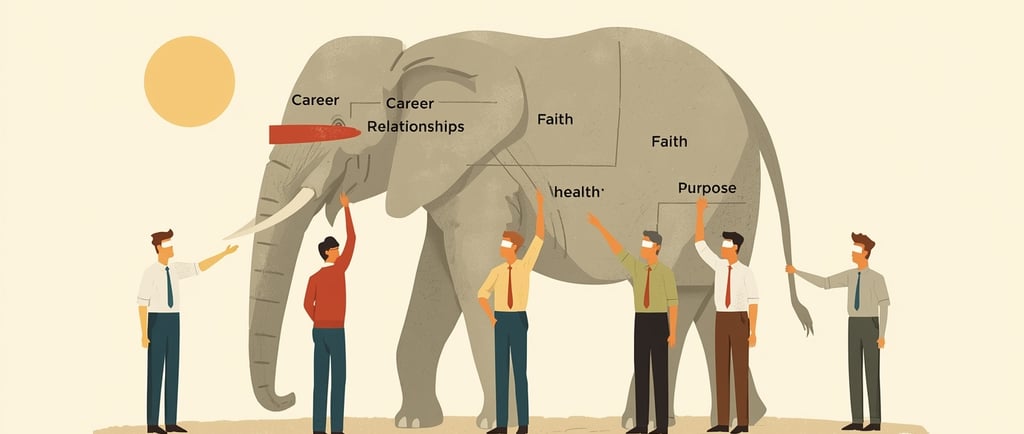
Once upon a time, six blind men came across an elephant for the first time.
Each reached out to touch it, eager to understand what an “elephant” was.
One touched the trunk and said, “Ah, the elephant is like a snake.”
Another felt the tusk: “No, it’s sharp and strong—like a spear.”
The third patted its side: “You’re both wrong. It’s like a wall.”
The fourth grasped the leg: “Clearly, it’s like a tree trunk.”
The fifth held the ear: “It’s like a large fan.”
The last pulled the tail: “Nonsense! The elephant is like a rope.”
Each was partly right, yet all were wrong.
Each saw only a fragment of the truth and mistook it for the whole.
2. How We See Life Like the Blind Men
We humans often live like the blind men in this ancient parable.
We touch one part of life — our career, our family, our culture, or our beliefs — and call it “the whole.”
Our understanding of life is shaped by where we were born, what we’ve been taught, and what we’ve experienced.
Geography, culture, knowledge, and personal history form invisible boundaries around our vision.
We may see only what is close to us — the “trunk” of success, the “ear” of comfort, the “tusk” of ambition — and yet, we wonder why life sometimes feels incomplete or disjointed.
We’re missing the full picture.
3. The Need for a Whole-Life View
Life is not a collection of separate parts — it is a living system.
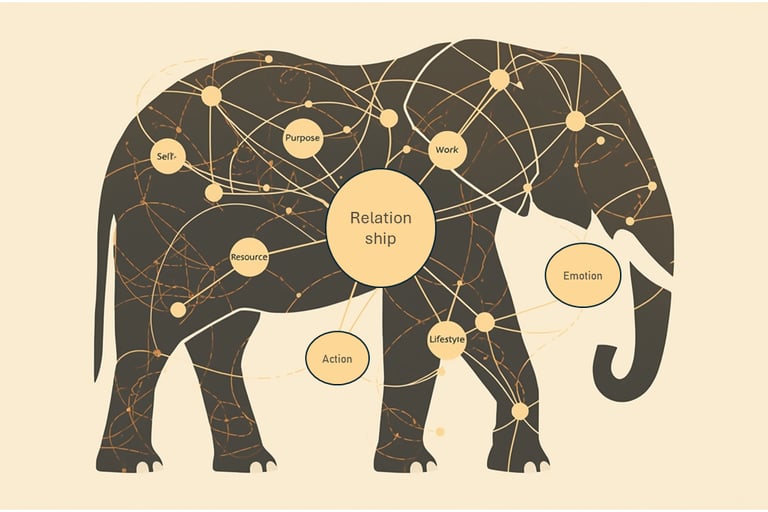
Our self, purpose, relationships, work, resources, and environment all interact like organs in one body.
Each affects the others in ways we rarely notice.
When we fail to see these connections, imbalance creeps in. We might build careers but lose our sense of purpose. We might seek peace yet live in systems that breed stress.
We might have love but lack direction.
To see life clearly, we must learn to step back — to perceive the integration among all aspects of who we are and what we do. That integration reveals not just how life works, but how it flourishes.
4. What Is Life Architecture?
Life Architecture is the art and practice of seeing life as a system — and designing it intentionally.
It borrows from the wisdom of architecture and systems thinking: to understand the structure, the purpose, the flow, and the relationships between all parts of our existence.
Just as an architect designs a building with vision, foundation, and structure, a Life Architect designs their life with clarity, alignment, and purpose. They don’t build blindly; they blueprint their path.
Through Life Architecture, we can explore questions such as:
What is my life built upon — what are my values and truths?
How do my relationships, work, and resources support or hinder my purpose?
What is the structure that sustains my growth and well-being?
It is a way of mapping life to see both the forest and the trees — the full elephant, not just its tail.
5. Integration: Seeing the Whole Elephant of Life
When we integrate our inner world (beliefs, identity, and purpose) with our outer world (actions, environment, and systems), we begin to live with a new kind of awareness — one that sees patterns, harmony, and flow.
Life Architecture helps us understand that clarity isn’t about having all the answers; it’s about seeing the connections — how the parts of life shape and support one another. With this awareness, we can design a life that is both balanced and beautiful.
6. Closing Reflection
The blind men were not wrong — they simply lacked perspective. So do we, until we learn to see beyond the part we touch.
When we step back and see the whole elephant of life, we gain not only understanding, but compassion — for ourselves and for others walking their own paths of discovery.
Life Architecture is not a rigid plan; it’s a way of seeing and designing life consciously, so that our days, dreams, and decisions align into one living masterpiece.